
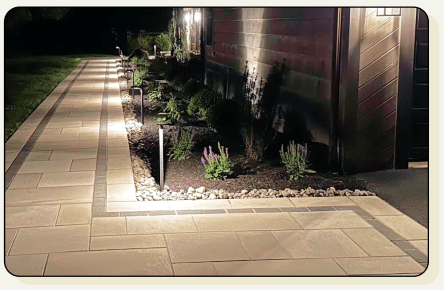
So here is the number, broken out by what each light is for.
How Much Does Landscape Lighting Cost?
Landscape lighting runs roughly $100 to $500 per fixture installed, and most professionally installed systems land between $2,000 and $6,000. At Clean Peak, lighting starts at $3,500, and most projects average $2,000 to $8,000 for 10 to 35 fixtures.
Where you land depends less on the size of your property than on how many things you want lit and what you light them with. A front walk and two trees is a different project from a full property with a patio, a sitting wall, and a stand of hardwoods. Our pricing page lists current ranges service by service.
What Landscape Lighting Costs by Type
| Light Type | Per Fixture, Installed* | What It Does for You |
| Path & walkway | $100–$250 | Lights the route to your door. A 60-foot walk usually runs $400–$1,500. |
| Uplighting & accent | $150–$350 | Throws light up a tree, a wall, or the front of the house. |
| Hardscape & ledge | $150–$400 | Tucks into walls and steps. Far cheaper installed during a build. |
| Step & deck | $100–$300 | Marks the edges people misjudge in the dark. |
| Downlighting / moonlighting | $200–$500 | Mounted high in a tree, casting dappled light down. |
| Whole system (10–35 fixtures) | $2,000–$6,000 typical | Clean Peak: from $3,500, averaging $2,000–$8,000. |
*2026 national installed ranges. Labor and materials in southeastern Pennsylvania sit above national averages, so local quotes tend toward the upper end.
Path and Walkway Lights
The most common place to start, and for good reason. That stretch of walk is the piece of your property every guest touches.
Path lights sit low and pool light down and outward, so the route is lit without glare in anyone’s eyes. A 60-foot walk usually requires six to ten fixtures, totaling $2,000 to $3,500.
The temptation is to line them up like runway markers. Stagger them instead and let the pools of light overlap. You get a lit walk that does not announce itself.
Uplighting and Accent Lighting
This is where the beauty lives. A fixture set at the base of a Norway spruce throws light up through the branches and turns a tree you barely register in daylight into the best thing on the property after dark. The same trick works on fieldstone, a chimney, or the front face of the house.
A little goes a long way here. Three or four uplights placed well will outperform a dozen scattered around the yard.
Hardscape and Ledge Lights
These tuck under the cap of a sitting wall, into the face of a retaining wall, or along the lip of a step. The fixture disappears, and all you see is light washing down the stone.
These cost far less installed while a wall or patio is going in than retrofitted afterward. If a hardscape project is anywhere on your horizon, this is a great time to include lighting.
Step and Deck Lights
Steps are where people misjudge in the dark, and a lit riser settles that for good. They also make an evening on the deck feel polished.
Downlighting and Moonlighting
These are fixtures mounted high in a tree and aimed down so dappled light falls through the branches onto the lawn or patio below. It looks like moonlight, and it is the loveliest effect available. However, it can be expensive in terms of labor pricing, since someone has to scale your trees to run the wires.
What Impacts the Price per Fixture
Fixture Material
- Brass and copper cost more upfront, last twenty years or more, and take on a patina as they weather.
- Stamped aluminum and plastic cost less, but they cloud, corrode, and fail within a few seasons.
Distance From the Transformer
A wire run under mulch is quick work. A run that has to cross a paver walk or a driveway requires more effort (and thus more labor costs).
What’s in the Ground
Rock, tree roots, and established beds all add time to the install.
Controls
Timers, photocells, dimming, and app control each add to the total. A photocell that brings the system up at dusk costs little and means you never think about it again.
The Part of the System You Will Never See
The transformer steps your home’s 120-volt power down to the 12 volts the fixtures use. If you size it exactly to the load you’re installing, the system runs at its max from day one. That means your lights may dim, flicker, or give out entirely, and you won’t be able to add another fixture later without replacing the entire transformer.
Instead, choose one with headroom, generally 25 to 50 percent above the fixture load, and you get a system that runs steady and leaves room to grow into.
Wire gauge works the same way. Thin wire over a long run means the fixtures at the far end can be dim, and no bulb swap will fix it. That is a design problem buried under six inches of mulch.
Too-small transformers and thin wire are why cheap systems are cheap. The same project can command wildly different prices if that’s where the installer is cutting corners. (Hint: Clean Peak doesn’t cut corners with our landscape lighting installations!)
What Does Landscape Lighting Cost Annually?
A modern LED system costs somewhere between $20 and $60 per year. The bulbs last 10 to 12 years, compared to two or three for the halogen systems they replaced. A well-built system holds up around 15 years. That makes lighting unusual among landscape projects. The spending is almost all upfront, and then you get a decade and a half of evenings out of it.
How Clean Peak’s Pricing Compares
Our published range works out to roughly $286 to $400 per fixture. National figures for professional installation in 2026 run $205 to $396, and labor and materials in southeastern Pennsylvania are above national averages.
Here is what our price point includes:
- One team throughout the design walk-through, install, and follow-up, so you’re not coordinating multiple vendors
- Fixtures chosen for our climate rather than for a shelf price
- A transformer sized with room to add fixtures later
- Wire runs and fixture angles worked out on your property after dark, not guessed from a daytime walk
- Nothing on the final invoice you did not approve
Where to Spend First
- Start at the front: The walk, the entry, and one or two trees give you the biggest visual return and fix the safety problem at the same time. That is usually 8 to 12 fixtures.
- Then the specimen trees: A pair of well-aimed uplights on the best tree in your yard does more than a dozen fixtures spread thin across the property.
- Then the back: Patio, sitting wall, steps, and the tree you look at from the kitchen window.
If a patio, walkway, or wall is in your plans, fold the lighting into that build. Bundled projects cost 10 to 20 percent less than standalone pricing, and hardscape lighting installed during construction costs a fraction of the retrofit.
Let’s Talk Numbers
Try our estimator for a price range in a few minutes. Then, reach out for a formal quote. We’ll walk you through the process and come visit your property to discuss how to make your outdoor spaces sparkle.
Frequently Asked Questions
How much does landscape lighting cost per fixture?
Between $100 and $500 installed, depending on the type of light and the fixture material. Path lights sit at the lower end. Downlighting mounted high in a tree sits at the top. Our pricing page lists current ranges.
How many lights does a front yard need?
Most front-of-house projects start around 8 to 12 fixtures. That typically covers the walk, the entry, and one or two trees. You can add to a well-designed system later.
Is low-voltage lighting worth it over a big-box kit?
For anything you want to keep, yes. Kit fixtures are usually aluminum or plastic and tend to cloud and corrode within a few seasons, and the transformers that come with them have no headroom. A professionally installed low-voltage system is built around fixtures and wiring that survive our winters.
How long does a landscape lighting system last?
Around 15 years for a well-built system. LED bulbs run 10 to 12 years. Brass and copper fixtures outlast both.
Can lighting be added to an existing landscape?
Yes. Wire runs under mulch and through beds with minimal disturbance, so an established landscape does not have to be torn up to light it.
